
- Ergonomic Products
- Ergonomic Furniture
- Yoga
- Meditation
- Pilates
- Air Treatment
- Blog
- Resources
- About Us
- Wholesale
- Ergonomic Products ▼
- Ergonomic Furniture ▼
- Yoga ▼
- Meditation ▼
- Pilates ▼
- Air Treatment ▼
- Blog
- Resources ▼
- About Us
- Wholesale
- Sign in

A yoga strap is a simple, affordable prop that helps you deepen stretches, improve alignment, and make challenging poses accessible at every level of practice. Whether you are working on tight hamstrings from desk work or trying to refine your dancer's pose, a strap acts as an extension of your arms, letting you hold positions longer and with better form. In this guide, we will walk through eight proven yoga strap stretches, explain who benefits most, and help you choose the right strap for your needs.

Our yoga straps are long and sturdy and made from organic cotton, with a D-ring at one end. You loop it around your foot, hand, or back to create tension that helps you hold a stretch with control.
Unlike a resistance band, a yoga strap does not stretch. That non-elastic quality gives you a stable, predictable anchor point so you can ease into a position gradually without straining.
If you are new to yoga, the yoga strap helps with:
Research published in the International Journal of Yoga found that prop-assisted stretching significantly improved range of motion in beginner practitioners compared to unassisted stretching alone (Polsgrove, Eggleston & Lockyer, 2016).
A yoga strap is not just for beginners. It is a tool that serves a wide range of practitioners:
Not all straps are the same. The material, length, and buckle type all affect how the strap feels and performs.
At Stretch Now, the yoga straps collection are made from organic cotton and are gentle on the skin and kind to the environment.
Most yoga straps come in 2 metre or 3 metre lengths. For most people, 2 metres is enough. If you are tall (over 180cm) or want to use the strap for deeper binds and more advanced shoulder openers, go for the 3 metre version.
Standard strap width is about 4cm. This width distributes pressure evenly across your foot or back. Thinner straps can dig in during long holds.
D-ring buckles are the classic choice. Two metal rings let you thread the strap through and cinch it tight.
They are simple, reliable, and will not slip. Most traditional yoga straps use D-rings.
Cam-buckle straps use a spring-loaded clamping mechanism. They are faster to adjust with one hand but can occasionally slip under heavy tension. For most yoga practices, D-rings are the safer bet.
These eight stretches cover your major muscle groups. Each one works whether you are a complete beginner or a seasoned practitioner looking to go deeper.
Sit on the floor with your legs extended straight in front of you. Loop the strap around the balls of your feet. Hold both ends of the strap and gently walk your hands forward along the strap, keeping your spine long.
The goal is not to touch your toes. The goal is to feel a steady stretch along the back of your legs without rounding your lower back. Hold for 30 to 60 seconds and breathe.
Lie on your back. Loop the strap around one foot and extend that leg toward the ceiling. Keep the other leg bent with the foot flat on the floor, or extend it straight for a deeper stretch.
Hold the strap with both hands and gently draw the raised leg toward you. This is one of the most effective stretches for tight hamstrings, and the strap lets you control the intensity precisely. Hold for 30 to 60 seconds per side.


Stand or sit tall. Hold the strap with both hands, palms facing down, about shoulder-width apart. Keeping your arms straight, slowly lift the strap overhead and then behind you as far as you can comfortably go.
Then bring it back to the front. This movement opens the chest and shoulders, which is especially valuable if you spend your day hunched over a computer. Start with a wider grip and narrow it as your shoulders loosen. Repeat 8 to 10 times.
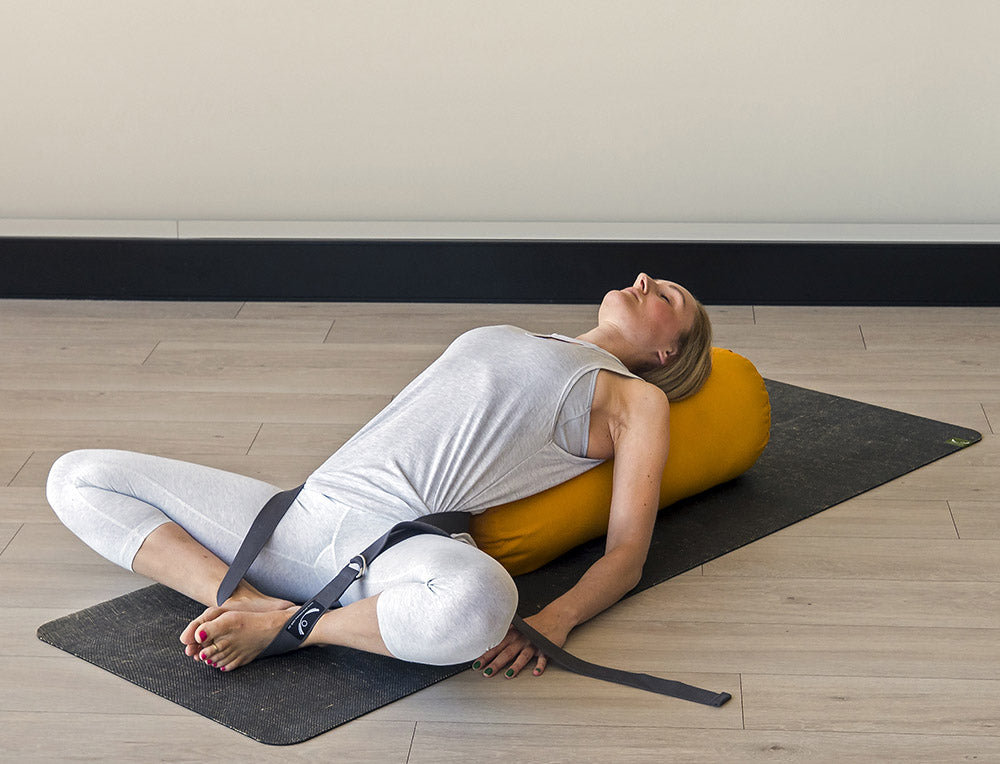
Lie on your back. Bring the soles of your feet together and let your knees fall open to the sides. Loop the strap around your lower back and under your feet to hold the shape.
This supported version of bound angle pose lets your hips open passively. It is a wonderful pose to hold for two to five minutes at the end of a practice. You can place a meditation cushion or yoga block under each knee for extra support.
Stand on one leg. Bend the other knee and loop the strap around the top of that foot. Hold the strap in the same-side hand.
Kick your back foot into the strap while reaching your other arm forward. The strap gives you the reach you need to find the pose without grabbing your foot, which requires significant shoulder and quad flexibility. Hold for 15 to 30 seconds per side.

From a wide stance, extend into triangle pose. Instead of reaching for the floor, place the strap under your lower hand and hold the other end.
This keeps your chest open and prevents you from collapsing forward. The strap essentially brings the floor closer to you. Hold for 20 to 30 seconds per side.
Lie on your back with the strap around one foot. Extend the leg straight up, then out to the side, then across your body.
Hold each direction for 20 to 30 seconds. This sequence stretches the hamstrings, inner thigh, and outer hip in succession. It is an excellent routine for runners, cyclists, or anyone who sits for long periods.

Stand in a doorway or near a wall. Hold the strap behind your back with both hands, about hip-width apart. Gently lift your arms away from your body while puffing your chest forward.
This counteracts the rounded-shoulder posture that comes from hours at a keyboard. Hold for 20 to 30 seconds. Repeat two to three times throughout the day.
Cotton straps can be machine washed on a gentle cycle with cold water. Hang them to dry.
Not really. Resistance bands stretch, which makes them unreliable for holding poses and maintaining alignment.
A yoga strap is non-elastic, giving you a stable anchor. Use resistance bands for strengthening exercises and a strap for stretching and pose support.
Yes, they are one of the best tools for hamstring flexibility. The reclining hamstring stretch with a strap lets you isolate the stretch without straining your back.
Hold the stretch for 30 to 60 seconds and breathe steadily. With regular practice, you will notice a meaningful improvement within a few weeks.
The "up and over" shoulder opener is an excellent starting point. Use a wide grip on the strap and move slowly through your range of motion.
If you feel sharp pain, stop immediately. Mild discomfort or a gentle stretch sensation is normal. The strap lets you control how far you go, which is important when working around existing shoulder issues.
Absolutely. Advanced practitioners use straps to refine alignment in binds, deepen backbends, and work on specific flexibility goals.
Think of the strap not as a beginner tool but as a precision tool. It helps you fine-tune positions that are difficult to hold without support.
Ready to explore? Browse the full yoga straps collection at Stretch Now, or pair your strap with a cork yoga block for even more versatility in your practice.

Ready to start meditating but not sure where to begin? This beginner-friendly guide covers the basics, from breath awareness techniques to building a consistent daily practice.


Yes, 10 minutes of yoga a day is enough. This guide includes a complete 12-pose sequence you can do anywhere, with step-by-step instructions and answers to the most common questions about short yoga practices.